Trying to find the words...
Putting words to our feelings when there's so much to feel



I don't know about you, but I've been struggling to find the words for how I feel about everything that's happening in the world. When I try to sort through it all, I freeze up.
The one thing I do know is that I'm feeling a lot. And I've done enough research on the power of words that I know that naming these feelings can help. But it's easier said than done. I'm sharing my personal struggle with this here—along with some research and tools that I'm using—in case it helps you find the words for what you're feeling, too.
If this article sounds familiar, it’s because I've written about these ideas before. This time, my hope is to go deeper and explore what it looks like to put these tools into practice.
Benefits of naming your emotions
There are so many words we can use to describe our feelings, but most of us stick to basic emotions: happy, sad, surprised, angry, scared... We're taught these words at an early age through posters featuring happy, sad, and surprised faces in classrooms. Or, when we're feeling a certain way as kids, an adult may tell us "you're feeling sad" or "you're feeling happy" and we learn to associate the sensations we're feeling with sadness or happiness.
Sometimes it's hard to even pinpoint those basic emotions. Sometimes we just feel good, bad, or fine—and sometimes we don't even know what we're feeling.
Some people are better at putting their feelings into words than others. And research shows that people who are good at differentiating their emotions benefit from it. Researchers in a study on emotion differentiation report that “labeling an emotion, or putting one's feelings into words, can help to downregulate” negative feelings.
Lucky for those of us who aren't as good at knowing how we feel, it's a skill we can get better at. Lisa Feldman Barrett, one of the researchers from the study and author of How Emotions Are Made, writes:
“Emotional granularity is a skill, and many people can increase theirs by learning new emotion concepts. I mean this literally: learning new words and their specific meanings.”
Putting words to how you feel
I've always found it difficult to put how I'm feeling into words. But I've come across a few tools that help—and they've seemed to resonate with people I've shared them with, too. They are: a feelings wheel for emotion words, a collection of untranslatable words in other languages, and a TED Talk from Erin McKean about making up words.
Emotion words
This feelings wheel has been a game changer for me. Originally developed by Dr. Gloria Willcox to support emotional literacy and communication, it's a super useful visual tool that helps people better identify, understand, and articulate their emotions.
You can think of it as a cheat sheet to help you figure out how you’re feeling. So let’s say you’re feeling happy. You can start in the middle with the primary emotion happy and work your way out to secondary emotions that stem from happiness: things like content, interested, proud, and accepted. Moving out a ring you'll find tertiary emotions, even more specific emotions you may be experiencing.
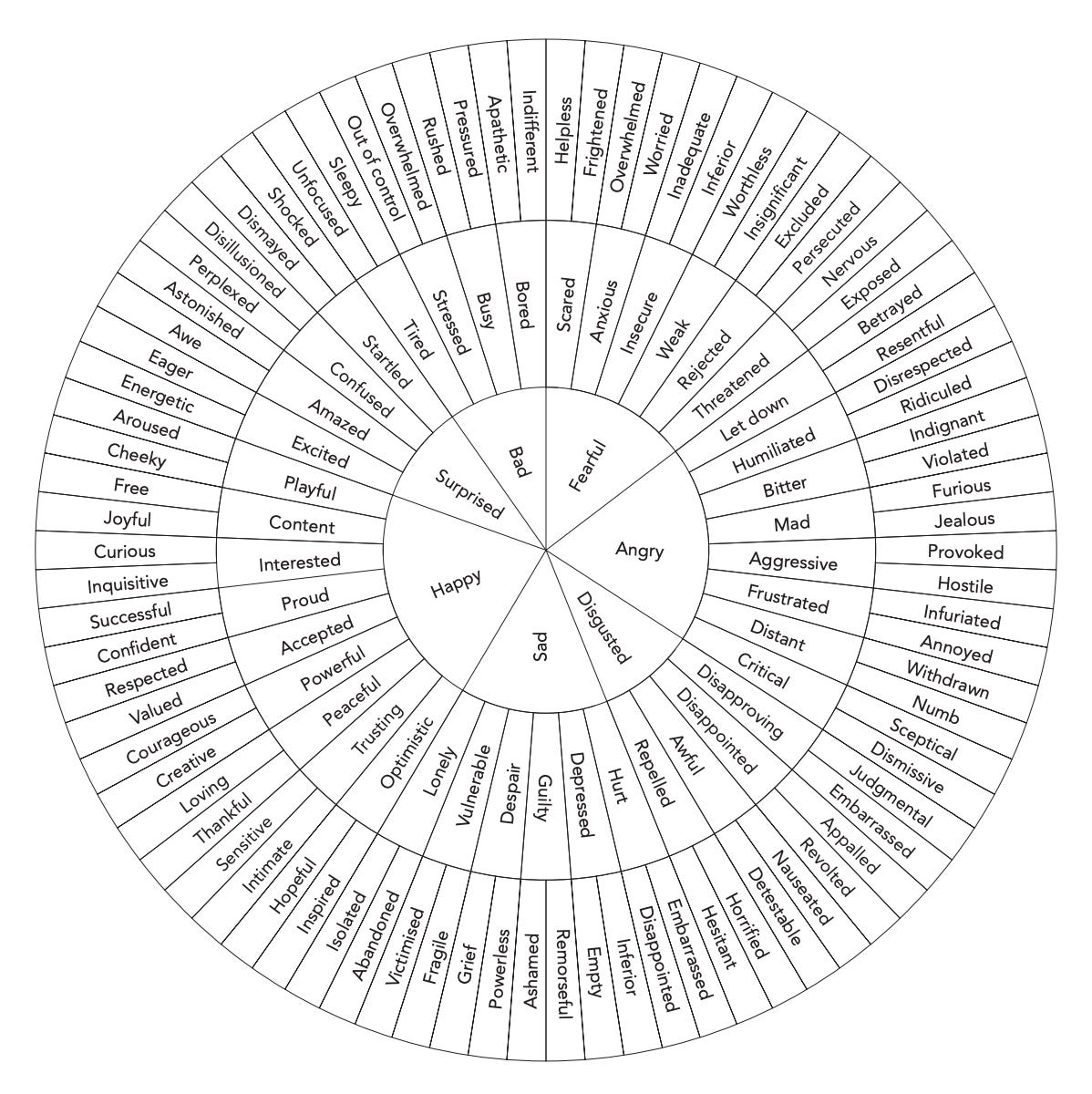
Considering the current state of the world, I've definitely been feeling some negative emotions. I wasn't sure exactly how to label them. But looking at the wheel, I can quickly put words to a few of the things I've been going through:
- I've been feeling bad and, moving out a ring, I can identify that I am stressed. Going out a level further, I see overwhelmed. There is so much going on in the world: dehumanizing ICE raids, ongoing global conflicts, and growing uncertainty about the future of democracy. I was laid off, AI has its own social networks now, and it's been freezing cold forever (just to name a few things). Now instead of just feeling bad, I can put my finger on exactly why. It makes sense to feel overwhelmed right now.
- Overwhelmed is also listed as a tertiary emotion under anxious, along with worried. I'm feeling all of this, too. I'm worried about the midterm elections, about what the future of work looks like for me in the age of AI, about a lot of things.
- I've been feeling sad, too. And when I consult the feelings wheel I can associate that sadness with despair and then with the word powerless. I want to do something to put an end to all the horrible things that are going on, but I feel powerless to do so.
- At the same time, I see inspired and hopeful on the feelings wheel and I think about how I feel when I see people rallying together to do something: to help their neighbors, call their representatives, donate money and time, get out and protest, and make their voices heard. And that makes me feel just a little bit better.
Going through this exercise, I can also identify actionable steps that help me feel better. If I’m feeling powerless but inspired by action, making calls, supporting nonprofits, and researching tangible ways to help makes me feel less powerless.
If you haven't yet, try spending some time with the feelings wheel. Try breaking down one of the basic emotions you've been feeling into a more granular one and see where it leads.
And if you still aren't finding an emotion word that resonates with how you're feeling, take a look at this Emotion Words Checklist from the American Psychological Association. For example, there I've found flabbergasted and concerned, both of which describe how I feel pretty much every time I open up the news these days.
Untranslatable words
Looking at the feelings wheel and the Emotion Words Checklist, you still may not find the exact word for what you're feeling. That's because, as Harvard Psychology Research Scientist Tim Lomas writes:
“English does not provide labels that perfectly suit every nuanced feeling… It’s an odd, uncanny event. Without being able to label the experience, we may struggle to register it at all, and certainly to understand and articulate it.”
Sometimes the word for what you're feeling does exist in another language, though. And getting to know these words can help us in the same way learning new emotion words can.
Tim Lomas has put together a collection of these words online at the Positive Lexicography Project. The project is focused on untranslatable words related to wellbeing and I highly recommend perusing the words there! You can sort by language or by themes like love, communality, cosiness, flourishing, and more.
For these times, though, I needed some untranslatable words that are a little less positive. Thanks to ChatGPT for helping me find these (I promise this task and some light proofreading is all I used ChatGPT for here—despite the fact that my love of em dashes may have you believing otherwise).
- Weltschmerz is a German word that translates literally to "world pain" and is described in Mental Floss as "a world weariness felt from a perceived mismatch between the ideal image of how the world should be with how it really is," or "a sadness in your heart for the world that can never be." This description resonates with how I feel as I see people on different sides of global and political conflicts move farther and farther away from one another, and from peace.
- Saudade is a Portuguese word that describes a nostalgia or longing for a person or thing that’s no longer present. It's the mix of happiness and sadness you may feel when looking at an old family photo, or the feeling of both happiness and loss you get when reminiscing about a relative who's passed. It's something I feel when I think back on the simplicity of life before social media, smart phones, and AI. A time when we had to find our way around without GPS, leave messages on people's answering machines when they were out, and things felt less intense.
I'll end on a more positive note with one of the words documented in The Positive Lexicography Project: Ubuntu, an African philosophy steeped in community and the idea that we are all a family and in this together.
In a speech at the Olympics opening ceremony just days ago, Kirsty Coventry described ubuntu:
"It means: I am because we are. That we can only rise by lifting others. That our strength comes from caring for each other. No matter where you come from, we all know this spirit—it lives and breathes in every community."
In the same way that I feel inspired and hopeful when I see people rallying together and making their voices heard, ubuntu helps me imagine what's possible when we embrace community.
As you can tell from the majority of the emotion words I've shared, things are heavy right now. And my intention is not to minimize that by ending on a positive note. I've done this because I believe that maintaining a glimmer of hope and optimism is needed if we want to remain inspired to take action and get ourselves and our communities to the other side.
Made up words
Last but not least, when all else fails, make up your own words! New words are being created all the time. And literally anyone can create them. When they get added to the dictionary they're called neologisms.
Pronoia is an example of a neologism that’s made a big impact on those that have learned it, fostering a more optimistic and resilient outlook on life. Coined in 1982, pronoia is the opposite of paranoia—the belief that the world is conspiring in your favor. Some more recent neologisms include hangry, selfie, mansplain, and adorkable.
Lexicographer Erin McKean shares tips for making up words in this super TED Talk called Go ahead, make up new words! She says, "You should make words because every word is a chance to express your idea and get your meaning across—and new words grab people’s attention."
Some made up words relevant to how I'm feeling these days are:
- News fatigue: OK, I guess this is technically a phrase and not a word, but I'm still including it. It's the tiredness and overwhelm from trying to stay informed about everything that's going on in the world and I am feeling this big time.
- Gaslit: This one isn't a new word, but an old word with new usage. It's the feeling when someone makes you question your own reality, and how I feel when I'm told something is true when I can see with my own eyes that it isn't.
- Wordstuck: I made this one up just now. It's when you just can't come up with the words for how you're feeling.
- Unwordstuck: This is the opposite of wordstuck! It's how you feel after you've taken some time to put words to how you're feeling.
Writing this has helped me unwordstuck myself just a bit and I hope you're feeling a little less wordstuck, too.
By the way, I'm currently working on turning this content into an online course. So please let me know if it resonated with you, if you have questions, or if there's anything else you think I should consider. Thanks for joining me on this journey!